
On the principle of least action
When the work is done, the aim fulfilled, they will say: “We did it ourselves.”

The Optimisation of Matter
We are taught that the universe operates like a micromanager. From our first physics class, we imagine reality calculating forces and accelerations millisecond by millisecond, aggressively shoving objects along rigid trajectories. But occasionally, in the course of personal education, you reach a peak in the woods where a vastly different landscape unravels. You discover a universe that doesn’t push at all, but rather lets systems naturally settle into the path of least resistance.
It starts with classical mechanics. Once fluent in differential equations, a physics student is introduced to a specific mathematical function. From high school, one remembers that boring fact of total energy conservation: kinetic T and potential V combined. Suddenly we are introduced to a dynamic one: T - V. It is called a Lagrangian.
Unlike total energy, which remains rigidly fixed, the Lagrangian fluctuates. If you tally up this balance of motion and potential at each time step from start to finish, you get a grand total for the journey. This accumulated cost is called the Action.
The universe operates on a single constraint regarding this totality: out of every conceivable path an object could take, the realised trajectory is always the one where the Action is stationary. You can picture this stationary state as the flat floor of a mathematical valley. It is the one optimal path where a tiny nudge or variation to the trajectory doesn’t alter the total cost.
This reveals a radically different way of thinking about motion. Rather than aggressively calculating Newton’s force and acceleration at every isolated instant, the system behaves as if it considers the whole journey at once, naturally settling into the path of least resistance. The rigid laws of early physics simply fall out from this elegant principle.
The Optimisation of Power
There is a famous line from Lao Tzu: “A leader is best when people barely know they exist. When the work is done, the aim fulfilled, they will say: ‘We did it ourselves!’”
This is the foundational text for wu wei, the philosophy of non-action. It argues that the absolute highest form of leadership doesn’t come from dictating every single step. It comes from setting up the environment so perfectly that the collective naturally and organically navigates to the right outcome.
When you really think about it, the principle of least action is simply the universe practicing wu wei.
The Newtonian framing invites us to imagine the universe as a micromanager. It hovers right over the baseball, rigidly calculating F=mg at every fraction of a millisecond, aggressively shoving the ball along its trajectory point by point.
But the variational view reveals a universe that leads without forcing. It doesn’t push. It establishes the landscape, the potential energy valleys. And it establishes the cost of moving through them, the kinetic energy. It defines the Lagrangian: T - V (kinetic less potential energy), and steps back. The formalism behaves as though every possible path were considered. It allows the system to exhaustively explore the mathematical possibilities and through differential equation minimisation, find the correct trajectory.
The optimisation is completely invisible. A thrown ball lands perfectly following a parabola, a chaotic chain of coupled mass blocks and springs naturally resolves into a synchronised, rhythmic oscillation, with the entire trajectory over time falling out of the equations. The particles could look back at the elegant, optimal path they just took and say: “We did it ourselves!” No micro-newton-manager required!
The Optimisation of Light
The other time this concept appeared for me, it cut even deeper. It came in a lecture series QED: The Strange Theory of Light and Matter by Richard Feynman. Aimed at the general reader, the lectures are notable for doing their utmost to avoid absolutely any equations. And they still fill the audience with a sense of observing the mechanics of reality. This time, not of blocks on springs or tennis ball parabolas, but photons traveling at the speed of light. The equations show them “exploring all possible trajectories,” and still arriving at the one that minimises travel time.
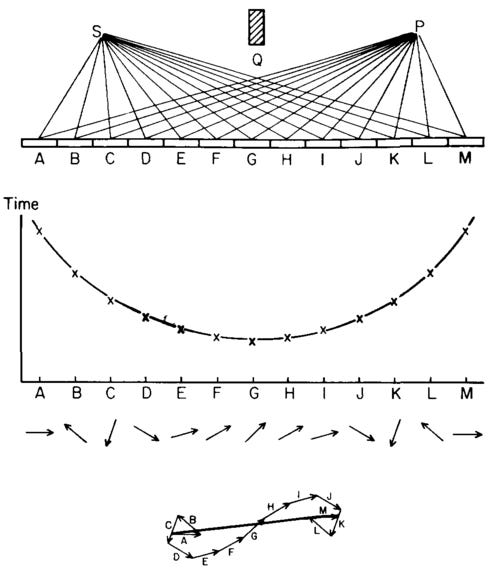
The above diagram represents the visual proof of the Path Integral formulation from Feynman’s QED: The Strange Theory of Light and Matter.
While we classically assume light simply reflects off the centre of a mirror, Feynman shows that a photon technically explores every possible path from source S to point P (A through M). Each path is assigned a “rotating clock” (a phasor arrow) whose direction is determined by the total travel time.
For the outliers (A, B, L, M), the travel time changes so rapidly that their arrows point in wildly different directions, creating a self-cancelling spiral of destructive interference. However, near the bottom of the time-parabola the travel time barely changes between paths. Here, the clocks stay in sync, their arrows stack tip-to-tail, and the resulting massive vector becomes the “quantum consensus.” This constructive interference is precisely what gives rise to the macroscopic principle of least action: the “true” path is simply the one where the quantum variations sum to a meaningful reality.
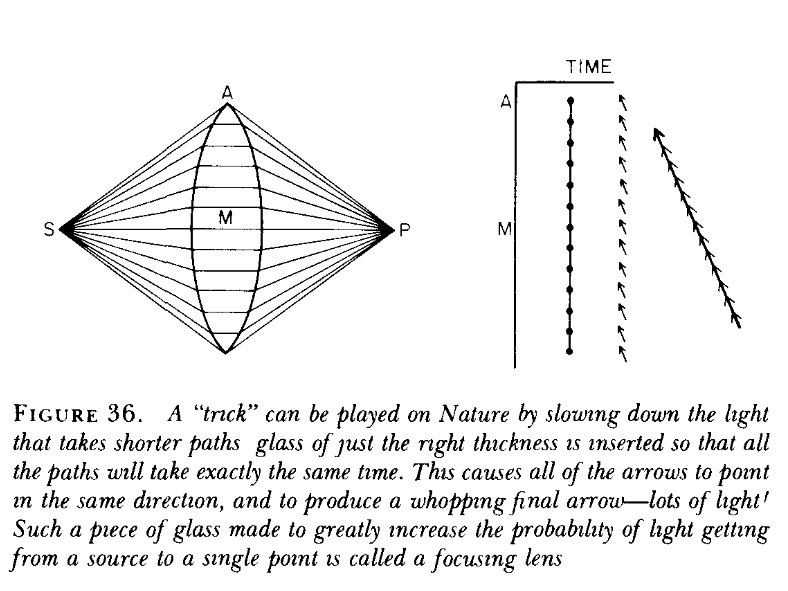
In a broader sense, it is again the kinetic minus potential energy, the electromagnetic (E, B) version of our original rule.
The Optimisation of Intelligence
In the old paradigm, we tried to micromanage computers. We wrote rigid, step-by-step, if-then rules to identify a face or translate a sentence. It was the Newtonian approach to coding.
With a modern neural network, you are not telling it how to process the data. You are defining a mathematical landscape built from thousands of observations. You shape a topography where the “correct” answer sits at the bottom of a deep valley. Then you let the system settle. Through iteration and feedback, it naturally drifts toward increasingly coherent solutions.
In Variational Autoencoders (VAEs), we don’t bother trying to calculate a “perfect” answer. Instead, we use variational calculus to search through a family of possible distributions to find the one that fits best. We aren’t looking for a point; we are looking for the path of least resistance through a space of possibilities. We define the “cost” of the landscape, and the system settles into the most stable configuration.
Intelligence emerges less from explicit instruction than from constructing the right landscape and allowing the system to find its own path through it.
The Optimisation of Everything
Whether it is a thrown ball tracing a parabola, a leader guiding a community, a photon reflecting off a mirror, or a neural network learning to see, the underlying philosophy is the same. The universe does not micromanage. It establishes the landscape, sets the rules of the terrain, and allows the entity to find its own elegant, optimal path. When we align our own systems, our code, our leadership, our thinking with this principle of least action, we stop fighting the friction of reality. We can become practitioners of the non-action.